Five-Handed Euchre: How to Play with 5 Players
Yes, you can play Euchre with five people, with everyone playing every hand. In the version taught here, you use 28 cards, choose a hidden partner each hand and keep five individual scores. Your partner may be sitting anywhere. Finding out who it is becomes part of the game.
This guide assumes you know basic four-player Euchre rules. For a different-sized group, see Three-Handed Euchre or six-player Double Deck Euchre. If your game uses numerical bids, start with our Bid Euchre rules guide; the auction versions differ from the game below.
What Changes in Five-Handed Euchre?
Compared with four-player Euchre, there are three main changes: four extra cards, no fixed partnerships and a separate score for each person. Ordinarily, the caller and one hidden partner face the other three players. When the caller plays alone, all four others defend.
We’re using the called-card game described by Gather Together Games as the foundation. Its brief tutorial leaves some details open, so this guide states its table conventions explicitly: complete any discard before calling a partner, award points to every member of the successful side, reserve the solo bonus for a declared loner, and share a tied winning score. Other tables may handle those details differently.
| Feature | Our game |
|---|---|
| Deck | 28 unique cards: 8 through Ace in every suit; no jokers or added 2s |
| Deal | Five cards each; three cards remain outside the hands |
| Partnership | Caller names a card; its holder is the hidden partner |
| Scoring | Five personal totals; temporary teammates earn the same award |
| Finish | At least 10 points; highest total wins, equal leaders share victory |
Deal and Choose Trump
Set Up the Deck and Deal
Add the four 8s to your usual 24-card Euchre deck. That makes 28 cards = 25 in players’ hands + 3 remaining. The 8s sit below the 9s; the familiar bower rules remain unchanged.
Choose a first dealer. Deal clockwise from the dealer’s left, giving everyone five cards in batches of two and three. Turn the top remaining card face up; the other two stay hidden. Deal moves one seat left after each hand.
Finish the Trump Call
Starting left of the dealer, each player may accept the upcard’s suit or pass. If accepted, the dealer picks it up and discards one card, returning to five. Complete that discard before the caller chooses a partner.
If everyone passes, turn the upcard down. Go around again, choosing a different suit or passing. If nobody calls before the dealer’s second turn, the dealer must choose. There is no pickup on a second-round call. Once trump and the partner choice are settled, dealer’s left leads; each trick winner leads next.
Choose Your Hidden Partner - or Go Alone
Name a Card, Not a Player
Before play, the maker names a card they do not hold, such as “Ace of spades.” Whoever holds that card is the partner for this hand. The holder knows immediately but cannot announce or signal it. Everyone else discovers the partnership through play.
The partnership exists from the start. Playing the named card reveals it; winning the trick does not create it. Your partner can reveal themselves by playing a card that loses, as the example below shows. The card table has acquired a small identity problem.
When No Partner Appears
The called card might be among the three cards out of play, including the dealer’s discard. Then the maker has no partner and must face four defenders. Keep that possibility in mind when choosing the call; a named card is no guarantee of help.
Alternatively, announce “alone” instead of naming a card. Nobody sits out: the maker faces the other four players. Under this guide’s convention, only an announced loner earns four points for taking all five tricks. A maker whose partner card was buried earns two for a sweep. Either kind of solo earns one for three or four tricks.
Five-Handed Euchre Scoring
Who Gets the Points?
Score the side’s combined result after all five tricks. Then enter the award separately for each person entitled to it. Do not split the points between partners, and do not require each teammate to win a trick. That is the individual-scoring convention used throughout this guide.
| Hand result | Maker / partner | Defenders |
|---|---|---|
| Partnered side takes 3 or 4 tricks | 1 each | 0 |
| Partnered side takes all 5 | 2 each | 0 |
| Partnered side takes 0, 1 or 2 | 0 each | 2 each of three defenders |
| Declared solo takes all 5 | Maker: 4 | 0 |
| Either kind of solo takes 3 or 4 | Maker: 1 | 0 |
| Undealt/discarded partner card; maker takes all 5 | Maker: 2 | 0 |
| Either kind of solo takes 0, 1 or 2 | Maker: 0 | 2 each of four defenders |
For example, if the maker takes all five tricks and the partner takes none, both receive two points. The same principle applies to defenders: a defender who takes no tricks still receives two when their side euchres the maker.
Who Wins the Game?
Keep five running totals. At the end of a hand, anyone reaching at least 10 can win. If several qualify, the highest total wins; equal highest totals share the victory. Two players moving from nine to ten therefore co-win. If the finishing totals are eleven and ten, eleven wins. Agree on this finish convention before dealing.
Worked Example: One Hand, Five Scores
The Card Reveals the Partner
Around the table clockwise sit Alex, Blair, Casey, Devon and Ellis. Ellis deals. Everyone passes on the 8♣ upcard, then Alex calls hearts and names A♠. No cards are exchanged. Casey holds A♠ and becomes Alex’s hidden partner.
Alex wins the first three tricks. On the fourth, Alex leads K♣. The cards appear in this order: Alex K♣, Blair A♣, Casey A♠, Devon A♦, Ellis 10♠. Casey, Devon and Ellis have no clubs left, so their plays are legal.
Casey’s A♠ reveals the partnership. Blair still wins with A♣: hearts are trump, and no trump was played. On the fifth trick, Blair leads Q♠ and Casey wins with K♠. Alex and Casey finish with four tricks between them; Blair has the other one.
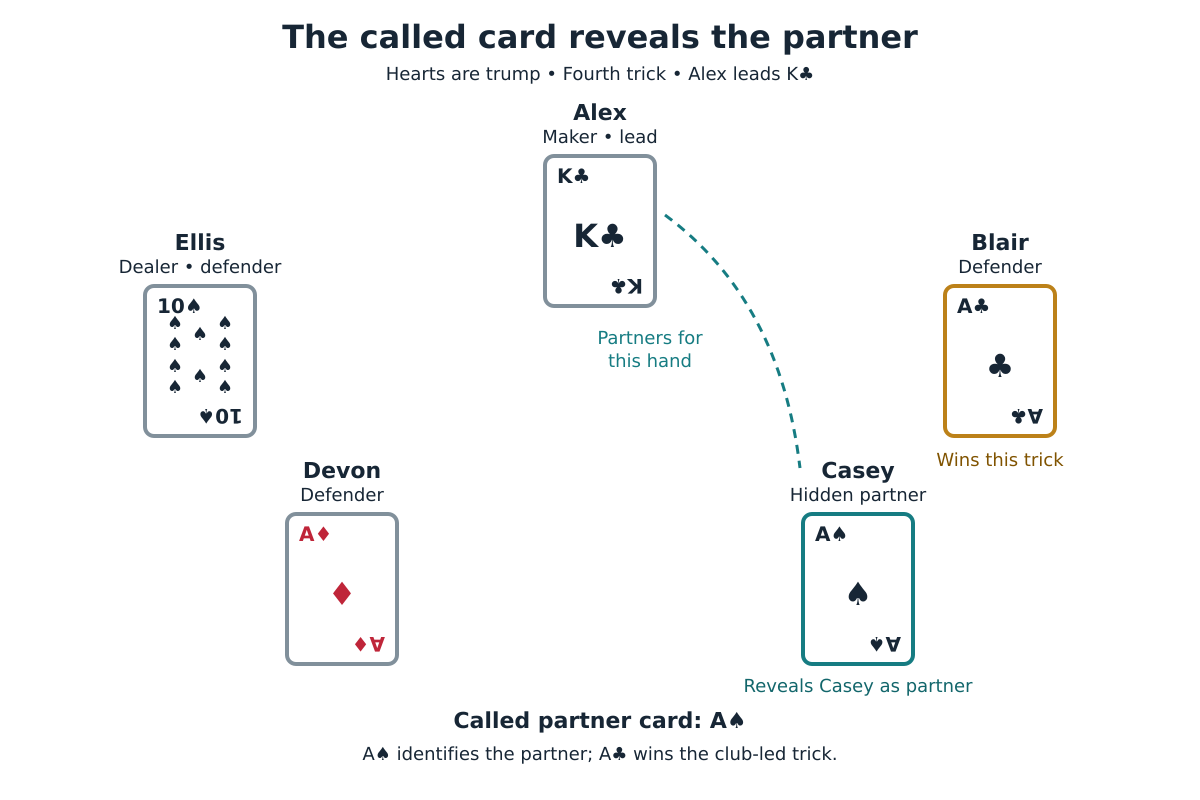
Casey reveals the partnership with A♠. Blair wins this trick with A♣.
Enter the Five Scores
| Player | Starting score | Hand award | New total |
|---|---|---|---|
| Alex | 6 | +1 | 7 |
| Blair | 4 | 0 | 4 |
| Casey | 3 | +1 | 4 |
| Devon | 5 | 0 | 5 |
| Ellis | 2 | 0 | 2 |
Alex and Casey each receive one point for their side’s four tricks. Blair’s one trick earns nothing because the defenders did not euchre Alex. Next hand, the partnerships can change; these personal totals stay put.
Other Five-Player Euchre Variations
“Five-handed Euchre” does not identify one universal ruleset. These are useful signposts for recognizing a different game, not complete instructions for the alternatives. Check the linked rules before switching versions.
| Version | What changes |
|---|---|
| This guide’s called-card game | 28 cards, named-card partner and the scoring conventions above. |
| Extra-trump version | Euchre.com adds four 8s and two high trumps to 24 cards: 30 total. The added 2s or distinguishable jokers outrank the bowers. Its scoring wording needs clarification before play. |
| Five-Handed Call Queen | Evan Wachter’s invented variant restricts the partner call, normally to the trump Queen. Makers gain or lose five; defenders count their own tricks. |
| Auction Euchre | Numeric contracts replace order-up calling. Cats at Cards describes 32 cards and a two-card widow; Foster’s historical version uses 28 and three. Partner counts depend on the bid. |
| Call Ace | A suit request identifies the partner through the highest qualifying held card. Cats at Cards and Foster describe different details; do not assume identical scoring. |
The auction distinction matters: bids of eight or fifteen do not promise eight or fifteen tricks in a five-trick hand. They represent special solo contracts. Likewise, a Call Queen scoring rule cannot simply be added to this guide’s scoring table. The names overlap more comfortably than the rules do.
Before the first deal, agree on the deck, partner call, solo bonus and finish convention. Write down five names, then start playing. You can leave the question of who your partner is for the cards to answer.