Three-Handed Euchre: How to Play and Keep Score
Yes, you can play Euchre with three people. In the five-card version explained here, everyone keeps an individual score. Whoever calls trump plays against the other two, who cooperate for that hand. On the next deal, those temporary partners may become opponents.
This guide uses a 24-card deck, no dummy hand, a three-point sweep and a ten-point game. We’ll also use stick-the-dealer and allow a shared win if both defenders reach ten together. Those are the table rules for this guide; “three-handed” or “cutthroat” can mean something different elsewhere.
Need the foundations? Start with our basic Euchre rules. Only two at the table? See two-handed Euchre. If your game uses numbered contracts, our Bid Euchre guide covers the foundations; the comparison below identifies the three-player alternatives.
What Changes from Four-Player Euchre?
The biggest change is whose tricks count. In four-player Euchre, your partner can help you make your point. Here, the caller must personally take at least three tricks. The other two players need three between them to euchre the caller, and both receive points if they succeed.
There are also more cards outside the players’ hands: nine rather than four. You won’t know whether a missing high card is with an opponent or sitting out the hand, so don’t treat every unseen card as a threat someone must be holding.
Keep three separate scores instead of two team scores. Each trick contains three cards, but the usual rankings, bowers and following-suit rules still apply. Nobody sits out, and there is no permanent partner to blame. You’ll have to rotate that responsibility too.
How to Deal and Call Trump with Three Players
Use the 9, 10, J, Q, K and A of each suit: 24 cards, with no jokers. Choose a dealer, shuffle, and deal clockwise in two rounds—two cards each and then three, or three and then two.
After dealing, everyone has five cards. Put the remaining nine in the middle and turn the top card face up. That leaves 15 cards in hands, one upcard and eight hidden cards. There is no fourth hand to pick up or play.
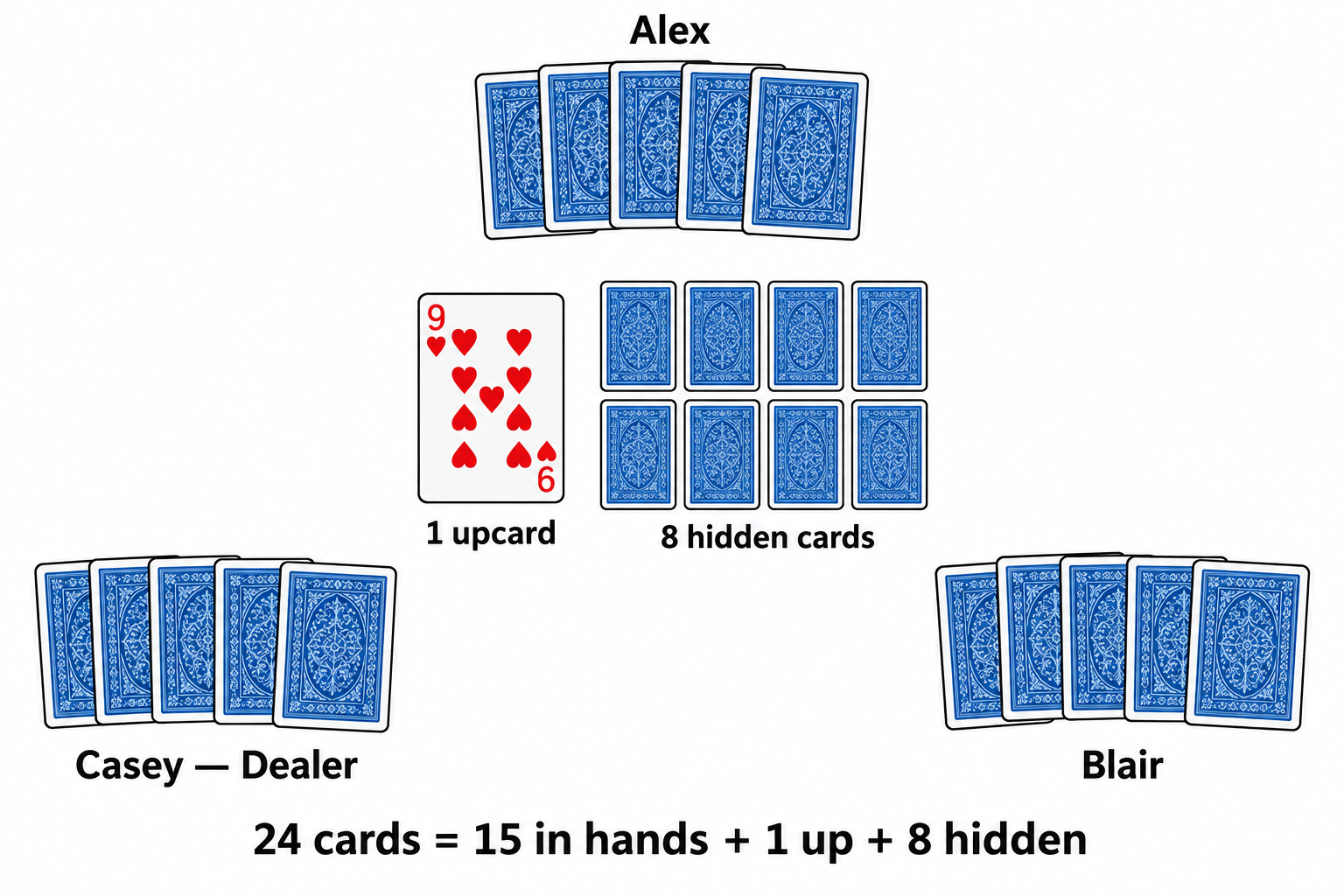
The initial deal: five cards each, one upcard and eight hidden cards.
Starting to the dealer’s left, each player may accept the upcard’s suit as trump or pass. If someone accepts, the dealer takes the upcard and discards one card face down, returning to five cards.
Ordering Up Still Gives the Card to the Dealer
Suppose Casey deals and turns up a heart. Blair orders it up: Blair is the caller, but Casey receives the heart and discards. Alex and Casey defend against Blair. Calling trump does not let Blair raid the undealt cards.
If everyone passes, turn the upcard down and start again to the dealer’s left. Players may name a different suit or pass; there is no card pickup in this round. Under our stick-the-dealer convention, if the first two players pass, the dealer must name one of the other three suits.
The player to the dealer’s left leads the first trick, regardless of who called. Play all five tricks, with each trick’s winner leading next, then score the hand. The deal moves one seat clockwise.
How to Score Three-Handed Euchre
Start everyone at zero and use the table below. These are points added after the hand, not points for individual tricks.
| Caller’s tricks | Caller | Defender 1 | Defender 2 |
|---|---|---|---|
| 3 or 4 | +1 | 0 | 0 |
| All 5 | +3 | 0 | 0 |
| 0, 1 or 2 (euchred) | 0 | +2 | +2 |
The defenders’ award is two points each, not two points split between them. A defender can take no tricks and still score if the other defender stops the caller. Conversely, defenders earn nothing when the caller makes three or more, even if they take the remaining tricks.
The caller is already playing without a partner, so this version has no separate “going alone” declaration or four-point loner bonus. Taking all five earns three. Some tables use a two-point sweep instead; settle that before the first hand.
A Three-Hand Scoring Example
Here’s how the scores change as Alex, Blair and Casey take turns calling. Each row shows the running totals after that hand.
| Hand | What happened | Alex’s score | Blair’s score | Casey’s score |
|---|---|---|---|---|
| Start | Everyone begins at zero. | 0 | 0 | 0 |
| 1 | Alex calls and takes 3; Blair takes 2; Casey takes 0. | 1 | 0 | 0 |
| 2 | Blair calls and takes 2; Alex takes 3; Casey takes 0. | 3 | 0 | 2 |
| 3 | Casey calls and takes all 5. | 3 | 0 | 5 |
Hand two is the useful one to notice: Casey wins no tricks but gains two points because Blair is euchred. Alex’s three defensive tricks benefit them both. This is not a game where every player must capture a trick to avoid a penalty.
What If Two Players Reach Ten Together?
Score the entire hand, then check whether anyone has reached ten or more. If exactly one player qualifies, that player wins. For this guide, if both defenders qualify on the same hand, they share the win—even if their final totals differ.
For example, Alex has eight, Blair has eight and Casey has six. Casey calls but takes only two tricks; Alex takes two and Blair takes one. Both defenders add two, finishing at ten together. Neither wins merely because someone wrote down their score first.
Shared victory is our house convention, not a universal cutthroat rule. The 1898 United States Playing Card Company rulebook already discussed simultaneous winners and used seating priority to resolve them. If your group insists on one winner, agree on another finish rule before playing. Eight–eight–six is a poor time to start negotiating.
Which Other Games Are Called Three-Handed Euchre?
If you remember bidding numbers, swapping for a spare hand or counting down toward zero, you may be remembering another game correctly. These documented versions share Euchre features but change much more than the number of chairs.
| Version | Cards and deal | What makes it different |
|---|---|---|
| Five-card cutthroat taught here | 24 cards; five per player; nine undealt | Caller versus two defenders; individual scores count up to ten. |
| Columbus three-player Buck | 24 cards; four five-card hands, including a widow; four unused cards | A player may swap for the widow before a numeric auction. Scores count down from 15. |
| Purdue Cutthroat Bid Euchre | 24 cards; seven per player; three-card kitty | Numeric bids; the winning bidder takes the kitty and discards back to seven. |
| Three-player Hoosier Bid Euchre | 32 cards: two copies of each J, Q, K and A; ten per player; two-card kitty | Numeric bids; the winning bidder picks up two and discards two. |
The Columbus details come from Pagat’s three-player Buck rules; the longer-hand games appear in its Hoosier and Purdue Bid Euchre descriptions. The table identifies the games rather than supplying their complete rules.
A widow is a spare hand, not automatically a partner whose cards you play. In the Columbus game, the exchange happens before bidding. That differs from winning a Bid Euchre auction and then taking a kitty.
Scoring changes the incentives too. In Columbus Buck, an active nonbidder who takes no tricks receives a penalty. In the five-card game taught here, the same zero-trick defender can earn two points. Don’t borrow that penalty while keeping this article’s defensive scoring.
Two Strategy Adjustments Worth Making
First, evaluate the call without counting on help. Ask where your own three tricks could come from. A hand you would call with a partner may need a second look here, particularly when ordering up improves an opponent’s hand. In Blair’s earlier example, Casey gets a heart before defending against Blair. That upgrade belongs in the decision.
This does not mean waiting for three guaranteed winners every time. Your score, seat and the risk of giving someone else the call still matter. The adjustment is to remove the imaginary partner from your hand evaluation.
Second, defend for the combined result. Once you can see that the caller has lost a trick, spending a higher card just to take it from the other defender usually achieves nothing. Both of you earn the same award for a euchre. There can be a reason to take the lead, but “I wanted the trick” isn’t much of one under these scoring rules.
Before dealing, agree on the five-card setup, sweep value, all-pass rule and finish convention. Then write down three names and start playing. The fourth player can catch up when they arrive.