Two-Handed Euchre: How to Play Euchre With 2 Players
Yes, you can play Euchre with just two players. The simplest version of Two-Handed Euchre uses a standard 24-card deck, with five cards dealt to each player. Turn up the top card of the remaining 14-card kitty and choose trump using the familiar two-round process. Play five tricks, with the nondealer leading first. The player who calls trump scores 1 point for winning three or four tricks, or 2 points for winning all five. If the caller wins fewer than three tricks, the opponent scores 2 points. The first player to 10 points wins.
There isn't one universally accepted version of Two-Handed Euchre. Besides the simple five-card game, there's a 12-trick tableau version that uses the entire deck and a dummy-hand version that lets players improve their hands after trump is called. All three use familiar Euchre concepts, but they offer very different styles of play.
If you already know regular Euchre and want to start playing with two people, begin with the five-card instructions below. It requires very little relearning. If you're new to trump, bowers, or following suit, check out our How to Play Euchre Guide first.
Have a different number of players?
3 players - check out the Three Handed Euchre Guide
5 players - read our Five Player Euchre Guide
6 players - then look at our How to Play Double Deck 6 Person Euchre Guide
Table of Contents
Which Two-Handed Euchre Version Should You Play?
All three games below use familiar Euchre concepts, but they don't feel the same.
| If you want... | Play... |
|---|---|
| The game closest to normal Euchre | Five-Card Two-Handed Euchre |
| A longer game with more card counting and visible information | 12-Trick Tableau Euchre |
| Normal five-trick Euchre with stronger, customizable hands | Dummy-Hand Euchre |
Two-Handed Euchre Instructions: Five-Card Version
This is the easiest answer to the question, "How do we play Euchre when there are only two of us?" Current rules sites independently describe essentially this same game, and the basic five-card structure has historical roots going back to the nineteenth century.
The Deck and Deal
Use the standard 24-card Euchre deck: 9, 10, Jack, Queen, King and Ace in each suit.
Choose the first dealer, then alternate the deal after every hand. Deal five cards to each player in the normal Euchre pattern of two and three cards at a time. Put the remaining 14 cards face down between the players and turn the top card face up.
That face-up card works exactly like the up card in regular Euchre.
Making Trump
The nondealer acts first. In the first round, the nondealer can order up the suit of the up card or pass. If the nondealer orders it up, that player becomes the maker, while the dealer picks up the upcard and discards one card face down.
If the nondealer passes, the dealer may accept the upcard and make its suit trump. The dealer picks it up, discards one card and becomes the maker. The dealer can also pass.
If both players pass, turn the upcard face down. The nondealer can now name any of the other three suits as trump or pass.
For these rules, use Stick the Dealer. If the nondealer passes again, the dealer must choose one of the three remaining suits. This avoids repeatedly throwing in hands when 14 cards are already sitting unseen in the kitty.
Playing the Hand
The nondealer always leads the first trick, regardless of who called trump. After that, the winner of each trick leads the next.
Normal Euchre rules apply. You must follow the suit led if possible. If you cannot follow suit, you may play any card, including trump.
The trump ranking is unchanged:
Right Bower → Left Bower → Ace → King → Queen → 10 → 9
Play all five tricks.
Two-Handed Euchre Scoring
Scoring is exactly the same as the 4 player version, but there are no alone hands so scoring maxes at 2 points:
| Result | Score |
|---|---|
| Maker takes 3 or 4 tricks | Maker scores 1 |
| Maker takes all 5 tricks | Maker scores 2 |
| Maker takes 0, 1 or 2 tricks | Defender scores 2 |
The first player to 10 points wins. There is no normal loner declaration because everyone is already playing alone. Winning all five is simply a two-point march.
What Happens to the Other 14 Cards?
Nothing. Once the upcard has done its job, the kitty stays out of play.
That creates the biggest strategic difference from four-player Euchre. In a normal game, you know that most of the cards you don't hold are in somebody's hand. Here, 14 cards start in the kitty, so the right bower you're worried about may not belong to your opponent at all.
Example: Playing a Five-Trick Hand of Two-Handed Euchre
Let's walk through a complete hand to see how dealing, choosing trump, playing tricks, and scoring work when there are only two players.
The starting hands
Alex (nondealer): J♥, J♦, A♠, Q♣, 9♦
Blair (dealer): A♥, K♥, 10♠, K♣, A♣
Upcard: 9♥
Alex has both red Jacks and decides to order up Hearts as trump. That makes Alex the maker. Blair picks up the 9♥ and discards the K♣, keeping five cards.
With Hearts as trump, the J♥ is the Right Bower and the J♦ is the Left Bower. Both are considered Hearts, and they're the two highest trump cards.
Playing the five tricks
Trick 1: Alex leads the J♥ (Right Bower). Blair follows suit with the 9♥. Alex wins with the highest trump.
Trick 2: Alex leads the A♠. Blair follows with the 10♠. Alex wins again.
Trick 3: Alex leads the J♦ (Left Bower). Even though it's printed as a Diamond, it counts as a Heart because Hearts are trump. Blair must follow suit and plays the K♥. Alex wins the third trick.
Trick 4: Alex leads the Q♣. Blair plays the A♣ and wins the trick.
Trick 5: Blair leads the A♥. Alex has no Hearts remaining, so Alex discards the 9♦. Blair wins the final trick.
How the hand is scored
Alex wins three tricks, and Blair wins two.
Because Alex called trump and successfully took at least three tricks, Alex scores 1 point. Blair scores nothing, even though Blair won two tricks.
If Alex had taken only two tricks, the call would have failed, and Blair would have scored 2 points for the euchre.
This example also illustrates an important difference from four-player Euchre: there is no partner to help win tricks. Alex needed to take three tricks personally, and holding both bowers made Hearts a strong choice for trump.
12-Trick Tableau Two-Handed Euchre
If someone says they grew up playing "two-handed Euchre," this may be the game they mean.
Instead of leaving most of the deck unused, all 24 cards are dealt. Each player has four cards in hand along with four visible cards and four hidden cards on the table. This version has especially strong evidence of actual community play in the Midwestern U.S. and Ontario, and closely related rules appear on multiple modern Euchre sites.
The rules below use the most consistently documented version of this format so you can sit down and play without having to make up any rules before you start.
The Deck and Deal
Use the normal 24-card Euchre deck.
For each player:
Deal 4 cards face down in a row on the table.
Deal 1 card face up on top of each face-down card.
Deal 4 more cards into the player's hand.
Each player therefore controls 12 cards:
4 in hand + 4 visible on the table + 4 hidden underneath
There is no kitty and no upcard. Every card in the deck will eventually be played.
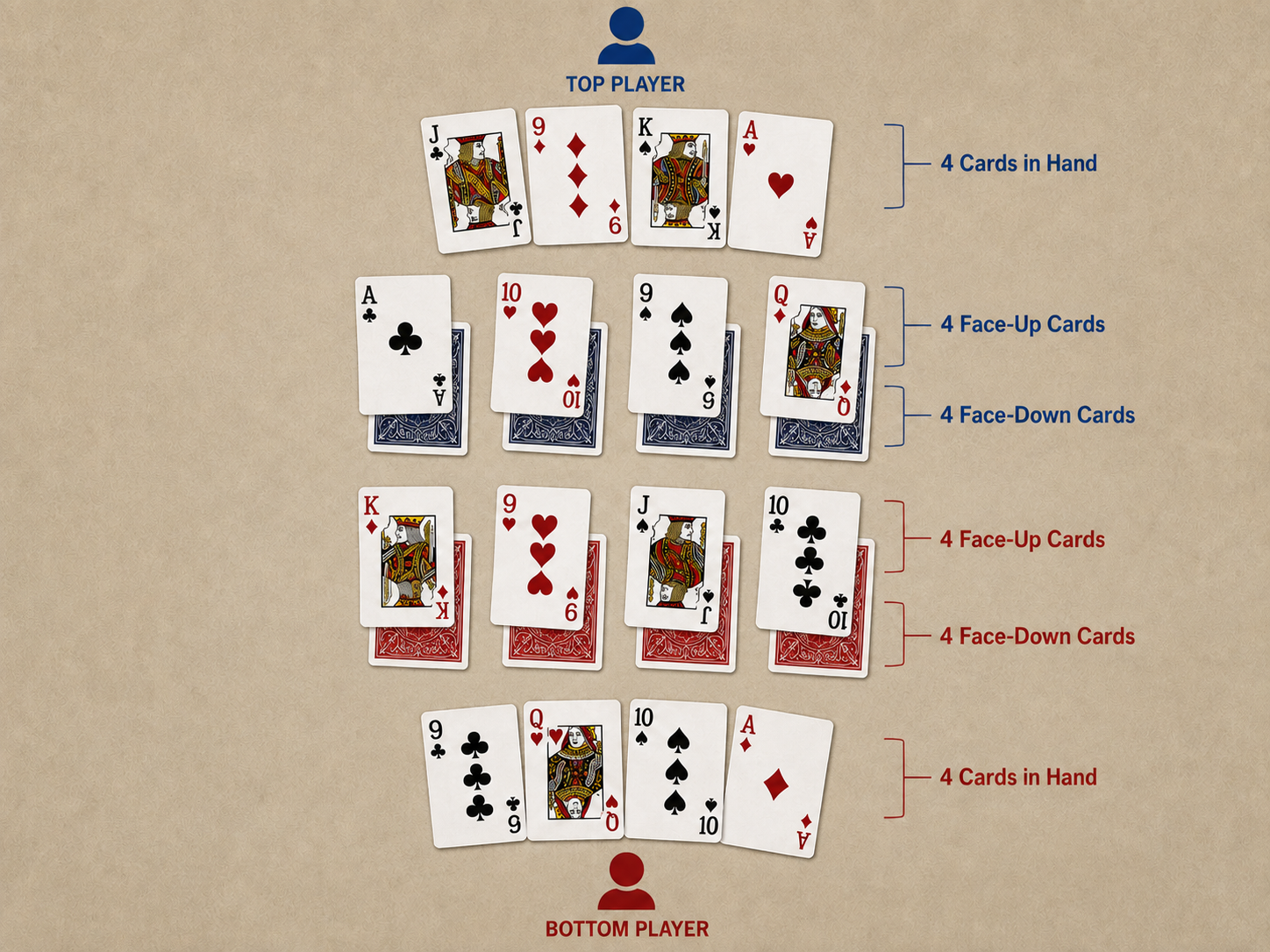
Starting layout for 12-trick Tableau Euchre with 4 cards in hand, 4 face-up cards, and 4 face-down cards per player.
Making Trump
The nondealer decides first and has only two choices: name a trump suit or pass.
If the nondealer names a suit, that suit is trump and the nondealer is the maker. If the nondealer passes, the dealer must choose a trump suit.
There is no order-up round and no turned card in this version. One of the players simply chooses hearts, diamonds, clubs or spades.
Playing Cards From the Table
The nondealer leads the first trick, even if the dealer called trump. On your turn, you may play any legal card from either the four cards in your hand or the face-up cards on the table in front of you.
You still must follow suit. That means your visible table cards count just as much as the cards in your hand when determining whether you can follow.
Suppose clubs are led and you have no clubs in your hand but a face-up club is sitting on your tableau. You must play a club because you have one available.
When you play a face-up table card, leave the card underneath it face down until the trick is finished. Once the trick is complete, turn that newly uncovered card face up. It becomes available beginning with the next trick.
The bowers and all other Euchre card-ranking rules work normally.
Winning and Scoring the Hand
There are 12 tricks, and the player who called trump must take at least 7 to make the hand.
| Result | Maker Scores | Defender Scores |
|---|---|---|
| Maker takes 7 tricks | 7 | 5 |
| Maker takes 8 tricks | 8 | 4 |
| Maker takes 9 tricks | 9 | 3 |
| Maker takes 10 tricks | 10 | 2 |
| Maker takes 11 tricks | 11 | 1 |
| Maker takes all 12 tricks | 12 | 0 |
| Maker takes 6 tricks or fewer | 0 | 12 |
If the maker takes at least seven tricks, each player scores one point for every trick they won. If the maker takes six or fewer, the maker is euchred and the defender receives all 12 points.
The first player to 31 points wins the game. Because there are only two players, there is no going alone.
Illegal Plays
With cards available both in your hand and on the table, following suit can occasionally be easy to overlook. Under this ruleset, an illegal play ends the hand and the opponent receives 12 points, the same result as a euchre.
That is a fairly good incentive to check the table before tossing an off-suit card.
Dummy-Hand Two-Handed Euchre
Dummy-hand Euchre keeps the familiar five-trick game but gives each player extra cards after trump has been chosen. The commonly repeated version used here gives each player a normal five-card hand plus a three-card dummy, then lets the player make the best five-card hand from those eight cards.
For this version, remove the 9s. That produces a 20-card deck, a documented approach that works cleanly with two five-card hands, two three-card dummies and four cards left for trump selection.
The Deck and Deal
Use these 20 cards:
10, Jack, Queen, King and Ace of each suit
Deal each player:
5 cards for their regular hand
3 cards face down as their personal dummy
Four cards remain. Put them face down as the kitty and turn the top one face up to propose trump.
Do not look at the dummy cards yet.
Making Trump
Call trump before either player sees their dummy. Use the same two-round process as the five-card game.
The nondealer may order up the turned suit or pass. If the nondealer passes, the dealer may accept it or pass.
If the turned suit is accepted, the dealer takes the upcard and discards one card.
If both players pass, turn the upcard down. The nondealer may name one of the remaining three suits or pass. If the nondealer passes again, use Stick the Dealer and require the dealer to choose one of the remaining suits.
Now trump is set.
Using the Dummy Hand
After trump has been determined, each player picks up their own three-card dummy and combines it with their five-card hand.
You now have eight cards. Choose the best five and discard the other three face down. Those discarded cards are out of play.
Both players do this before the first trick. You can keep extra trump, throw away weak singleton suits, or deliberately create a void if the dummy gives you enough useful cards to do it.
Going Alone
The maker may declare alone before looking at the dummy.
If you go alone, leave your three dummy cards face down and play only the original five-card hand. Your opponent still gets to pick up and improve their own hand.
Use standard loner-style scoring for that added risk. If the maker takes all five tricks without using the dummy, score 4 points. Taking three or four still scores one, while being euchred still gives the defender two.
Playing and Scoring
The nondealer leads the first trick. Follow normal Euchre rules, including the right and left bowers, following suit and allowing any card when void.
Because the 9s were removed, trump ranks:
Right Bower → Left Bower → Ace → King → Queen → 10
Play five tricks. First to 10 points wins.
| Result | Score |
|---|---|
| Maker takes 3 or 4 | 1 |
| Maker takes all 5 after using dummy | 2 |
| Maker takes all 5 after declaring alone | 4 |
| Maker takes fewer than 3 | Defender 2 |
Two-Handed Euchre Rules Compared
| Rule | Five-Card | 12-Trick Tableau | Dummy-Hand |
|---|---|---|---|
| Deck | 24 cards | 24 cards | 20 cards |
| Normal hand | 5 | 4 | 5 |
| Extra cards controlled | None | 8 table cards | 3-card dummy |
| Cards unused | 14 | 0 | 4 before dummy discards |
| Tricks | 5 | 12 | 5 |
| Trump selection | Standard 2 rounds | Nondealer calls or dealer must call | Standard 2 rounds |
| Nondealer leads | Yes | Yes | Yes |
| Normal bowers | Yes | Yes | Yes |
| Maker requirement | 3 tricks | 7 tricks | 3 tricks |
| Game target | 10 | 31 | 10 |
| Loner | No | No | Yes, by refusing dummy |
| Similarity to regular Euchre | Very high | Low–medium | High |
Which Version Is Most Common?
There is no reliable count of people playing each version, so it makes more sense to judge popularity by how often a version appears independently on rules sites, in player discussions, in historical sources and in current implementations.
By that measure, the five-card game and 12-trick tableau game form the clear top tier. The five-card version has the stronger current search and instructional footprint, appearing on several modern rules sites and in a current two-player app. The tableau game has the stronger community footprint, with independent rule descriptions, specific Illinois and Ontario connections and multiple player discussions in online forums.
Dummy-hand Euchre shows up often enough to be a legitimate third version. Its rules are less consistent from source to source, though, and it appears considerably less often than the first two families.
So I wouldn't claim that one version is the standard two-handed Euchre game. Based on what is actually visible online, a better conclusion is:
Five-card Euchre and 12-trick tableau Euchre are the two major forms. Dummy-hand Euchre is a well-established but less prevalent alternative.
How Strategy Changes With Two Players
If you've played a lot of regular Euchre, the mechanics won't be the difficult part. The bigger adjustment is realizing how many of your normal decisions are built around having a partner.
Five-Card Euchre Has a Lot of Unknown Cards
In the five-card game, 14 cards start in the kitty. That makes some normal card-reading assumptions much weaker.
If you hold the left bower but not the right, for example, you cannot automatically treat the right as a likely opponent card. With such a large kitty, it may never appear. The same thing applies to side-suit aces andmissing trump.
Your calling standards also change because nobody is helping you take that third trick. A marginal hand that you'd happily call with a useful partner across the table can be much less attractive heads-up.
Tableau Euchre Gives You Much More Information
The tableau version moves in almost the opposite direction. Eight of your opponent's 12 cards eventually appear on the table, and four are visible immediately.
You aren't merely counting what has already been played. You're also planning around cards that you already know are coming. Sometimes playing one exposed card is valuable specifically because you want to uncover the card underneath it.
That's why the 12-trick game feels less like a stripped-down Euchre substitute and more like its own strategy game.
Dummy-Hand Euchre Rewards Hand Building
Dummy Euchre adds uncertainty before the call and flexibility afterward.
You must decide whether to make trump before seeing your three extra cards. Once the dummy arrives, the decision changes from Can I make this hand? to What is the strongest five-card hand I can build?
Creating voids becomes especially important. If the dummy lets you discard the only card from a weak side suit, a card that looked useless before the pickup can suddenly make your whole hand stronger.
A Short History of Two-Handed Euchre
Two-player Euchre isn't a recent attempt to rescue card night when two people cancel.
A two-handed version was documented by George Frederick Pardon in 1863. That older game used a 32-card deck rather than today's usual 24-card pack, but the structure is remarkably familiar: five cards per player, an up card, two rounds of choosing trump and five tricks. Hoyle's Games Modernized was still describing a similar two-player game in 1909.
Later published versions became more experimental. The Columbus Book of Euchre, first published in 1982 and revised in 1999, documented extra-hand and straw-man approaches.
The 12-trick tableau version also has specific evidence of community transmission. One of the best documented modern descriptions comes from Joe Chellman, who says he learned the game from a player in Ottawa, Illinois. Closely related tableau versions also appear in Ontario accounts and on several modernEuchre sites.
By the modern internet era, both the simple five-card game and full-deck tableau games had developed substantial online footprints.
The common thread is easy to see. Every two-player Euchre version has to answer the same question: What should we do with the cards that normally belong to the other two players?
Five-card Euchre says, "Leave them out." Tableau Euchre says, "Play them all." Dummy Euchre says, "Give us some of them and let us improve our hands."
Other Two-Player Euchre Variations
Those three aren't the only ways people have adapted Euchre for two. There is also reduced-deck Euchre, extra-hand Euchre, draw Euchre and draft/market Euchre, but they have a noticeably smaller current internet footprint.
Reduced-deck Euchre strips the deck down further and plays only four tricks. Extra-hand Euchre deals each player two separate five-card hands and allows exchanges. Draw and draft versions let players improve their hands from a stock or a visible card market before play begins.
They're interesting games, but if two experienced Euchre players simply want something to play when nobody else is around, I'd start with one of the three versions above.
Which One Should You Try First?
Start with five-card Two-Handed Euchre. It feels enough like regular Euchre that you'll be playing almost immediately instead of spending half the first game checking the rules.
After a few games, the giant kitty may either become part of the appeal or start bothering you. If you want every card to matter and prefer more information to work with, try the 12-trick tableau version. If you'd rather keep the familiar five-trick format but want stronger hands and more decisions, dummy-hand Euchre is the middle ground.
There may not be one official way to play Euchre with two people, but that's not much different from Euchre with four. Give Euchre players enough time and they'll eventually find something to argue about before the first card is played.